
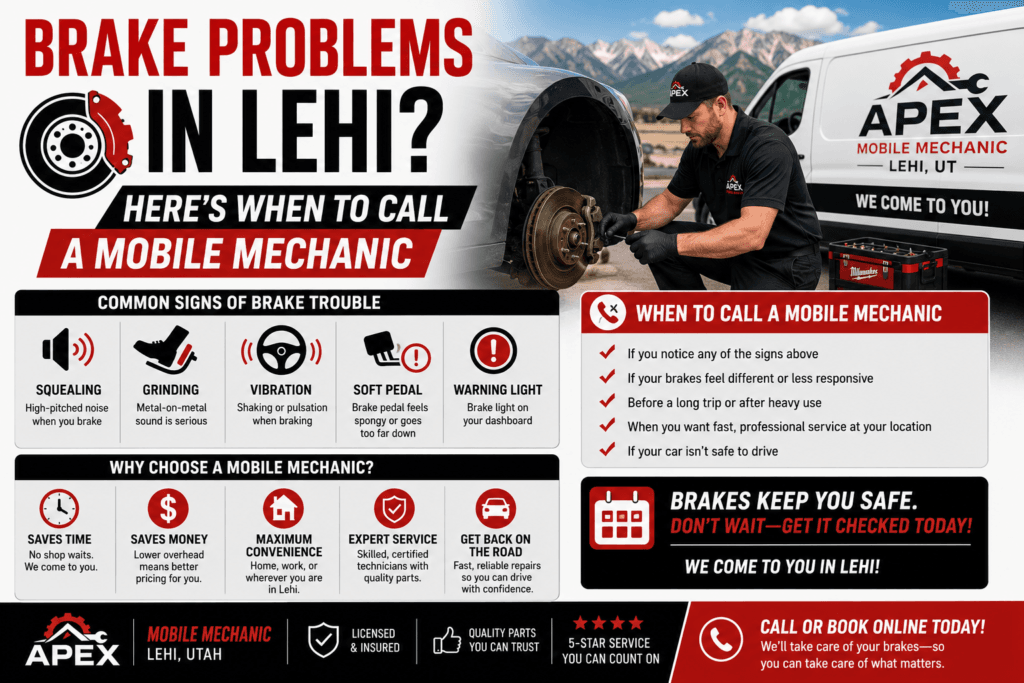
Your brakes are the single most important safety system on your vehicle. Everything else — the engine, the transmission, the steering — exists to move you from place to place. Your brakes exist to stop you from becoming a statistic. When they start showing signs of trouble, the margin for delay is smaller than most drivers realize.
The problem is that brake issues tend to develop gradually. What starts as a faint squeal becomes a grind. What starts as a slightly soft pedal becomes one that sinks toward the floor. By the time the warning is impossible to ignore, the repair has usually become more expensive and the safety risk more serious than it needed to be.
If you are driving around Lehi, Utah and something about your brakes does not feel right, this guide is for you. It covers the most common brake warning signs, what they mean in plain language, when to stop driving immediately, and how a mobile mechanic in Lehi Utah can handle the repair right at your home or workplace — without a tow truck, a shop appointment, or a disrupted day.
Why Brake Health Matters More in Utah Valley
Lehi sits in a part of Utah that demands more from vehicle braking systems than many drivers give it credit for. The Wasatch Front geography means regular elevation changes — whether you are coming off the Point of the Mountain on I-15, navigating the hills around Silicon Slopes, or heading up toward Highland and American Fork. Prolonged downhill driving generates significant heat in brake rotors and pads, accelerating wear and increasing the risk of brake fade if the system is already compromised.
Add to that the seasonal swings Utah Valley experiences — icy roads in winter, hot dry summers, and the kind of rapid temperature changes in spring and fall that cause metal components to expand and contract repeatedly — and you have a braking environment that puts real stress on your vehicle’s stopping system year-round.
Local driving patterns matter too. Lehi’s rapid growth means more stop-and-go traffic on Traverse Ridge Road, State Street, and the corridors around the tech campus district. Frequent stops wear brake pads faster than highway driving, and many Lehi residents are putting on more city miles than they did just a few years ago.
The point is that brake maintenance in Lehi, Utah is not a once-every-few-years consideration. It is something that warrants regular attention — and when warning signs appear, prompt action. You can see the full range of brake and safety-related services available through the services page.
The Most Common Brake Warning Signs — And What They Mean
Understanding what your vehicle is telling you is the first step to knowing when to act. Here are the brake warning signs Lehi drivers most commonly encounter, and what is likely happening when each one appears.
- Squealing or High-Pitched Squeaking
This is the most common early brake warning, and it is not accidental. Most modern brake pads are manufactured with a small metal wear indicator — a tab that contacts the rotor and produces a squealing sound specifically designed to alert the driver that the pads are getting low. If you hear this sound consistently when braking, your pads are likely approaching the end of their service life.
In dry Utah summer conditions, this sound may be more pronounced due to dust and heat. In winter, it can sometimes appear briefly when brakes are cold and wet before warming up — that is generally not a concern. Persistent squealing during normal driving and braking is the version that warrants attention.
Catching worn pads at this stage is the best-case scenario. Pad replacement at this point is a straightforward, relatively affordable repair that a mobile mechanic in Lehi Utah can complete at your home in one to two hours. Waiting beyond this point is where things get more complicated and more expensive.
- Grinding or Metal-on-Metal Sound
If squealing has progressed to a grinding sound — particularly a harsh, low metallic scraping that you may feel as well as hear — the brake pads have likely worn through completely. What you are hearing is the metal backing plate of the pad making direct contact with the rotor.
This is a situation that requires immediate attention. Metal-on-metal contact damages the rotor surface rapidly. A rotor that might have been resurfaced or left in service a week ago may now need full replacement. A repair that cost a few hundred dollars yesterday can double or triple in cost after a few more days of driving on destroyed pads.
Beyond cost, grinding brakes are a safety concern. Stopping distance increases, braking becomes less predictable, and in severe cases the rotor can be compromised to a point where braking effectiveness is significantly reduced.
Do not continue driving on grinding brakes beyond what is necessary to park the vehicle safely. This is the point where calling for auto repair in Lehi UT is not optional — it is urgent.
- Brake Pedal Feels Soft, Spongy, or Sinks to the Floor
A properly functioning brake pedal should feel firm and responsive. If yours feels soft, spongy, or requires unusually deep pressure before the brakes engage, something is wrong with the hydraulic system that applies braking force.
The most common causes are air in the brake lines, a brake fluid leak, or a failing master cylinder. All of these compromise the hydraulic pressure that translates your foot pressure into clamping force at the wheels. A spongy pedal that has developed gradually may indicate the system needs a fluid flush and bleed. A pedal that suddenly sinks to the floor is a more acute concern and should be treated as an emergency — this vehicle should not be driven until inspected by a professional.
Air in the lines or a fluid flush can often be addressed by a qualified car mechanic in Lehi on location. A failing master cylinder is a more involved repair but still within the scope of what a well-equipped mobile technician can handle for most vehicle makes and models.
- Pulling to One Side When Braking
If your vehicle pulls noticeably to the left or right when you apply the brakes, the braking force is not being applied evenly across all four wheels. This can result from a stuck caliper that is applying pressure on one side only, uneven pad wear, a collapsed brake hose restricting fluid flow to one caliper, or a seized slide pin preventing a caliper from releasing properly.
Uneven braking is a handling issue as well as a safety issue. In a hard-stop situation — especially on Lehi’s roads in icy or wet winter conditions — a vehicle that pulls under braking can be very difficult to control. This symptom should not be dismissed as a minor inconvenience. It indicates a specific mechanical fault that needs to be diagnosed and corrected.
- Vibration or Pulsing in the Brake Pedal or Steering Wheel
If you feel a rhythmic pulsing or vibration through the brake pedal or steering wheel when slowing down, the most likely cause is warped rotors. Rotors can warp from repeated heavy braking that generates excessive heat, from uneven torquing of wheel bolts, or simply from age and wear. As the rotor surface is no longer perfectly flat, the pads contact it unevenly with each rotation — creating that pulsing sensation you feel at the pedal.
Mild warping can sometimes be addressed by resurfacing the rotors. More significant warping typically requires full rotor replacement. Either way, this is a repair that brake repair in Lehi can address on location, and catching it early preserves the option of resurfacing rather than replacement.
- The Brake Warning Light Is On
Modern vehicles have brake system warning lights that illuminate when the onboard computer detects a problem. This can indicate low brake fluid, a hydraulic system fault, a malfunctioning ABS sensor, or a parking brake left engaged. If the warning light comes on and stays on during normal driving, it deserves a diagnostic inspection rather than being dismissed.
Some brake warning light causes are minor. Others are significant. The only way to know is a proper diagnostic scan and inspection — something a mobile mechanic can perform at your location without requiring you to drive a potentially compromised vehicle to a shop.
When to Stop Driving and Call Immediately
Most brake symptoms allow a short window to book a repair appointment before the situation becomes critical. A few do not. Call a mobile mechanic in Lehi Utah right away — and avoid driving the vehicle if at all possible — in the following situations.
The brake pedal sinks to the floor or requires pumping to build pressure. You hear or feel a severe grinding accompanied by significantly reduced braking power. The vehicle pulls sharply and unpredictably to one side under braking. You smell burning near the wheels after driving, which can indicate a seized caliper generating extreme heat. Any combination of the above.
In these situations, the risk of driving to a shop outweighs the convenience. The right call is to park the vehicle safely and have the mechanic come to you. That is precisely what mobile auto repair in Lehi UT is designed for — and Indianapolis Mobile Mechanic Pros has the equipment and experience to assess and address urgent brake situations on location. Reach the team immediately through the contact page.
How Neglecting Brakes Turns a Small Repair Into a Big Bill
This point deserves direct attention because the cost difference between acting early and waiting is significant. Here is a practical illustration of how brake neglect compounds.
A standard brake pad replacement on a common sedan or SUV — the kind of repair triggered by the early squealing warning — typically costs a few hundred dollars including parts and labor. If those pads are allowed to wear through completely to metal contact, the rotors sustain damage that often requires full replacement alongside the pads. That repair can cost two to three times more. If a seized caliper develops as a result of uneven wear and heat stress on a neglected system, add more still.
Beyond the mechanical costs, there is the liability of driving on compromised brakes. Utah traffic law holds drivers responsible for maintaining vehicles in safe operating condition. An accident in which brake failure is a contributing factor carries legal and financial consequences that dwarf the cost of any repair.
The math is straightforward: early brake service is inexpensive. Late brake service is costly. Brake failure is worse than both.
Serving Lehi and the Surrounding Utah Valley Communities
Mobile Mechanic Lehi provides brake repair and full automotive service across Lehi and the surrounding Utah Valley area, including American Fork, Highland, Cedar Hills, Eagle Mountain, Saratoga Springs, and parts of Orem and Provo. Service is available seven days a week, and same-day appointments are frequently accommodated for brake inspections and common repairs.
If you are not sure whether your location falls within the service area, the fastest way to confirm is to reach out directly through the contact page. The full range of services beyond brake repair — including battery replacement, oil changes, diagnostic services, and more — is available on the services page.
Brake warning signs — squealing, grinding, a soft pedal, pulling, pulsing, or an illuminated warning light — should never be dismissed or monitored indefinitely. Each one indicates a specific mechanical issue that worsens with time and driving.
Utah Valley’s geography, seasonal conditions, and growing stop-and-go traffic make brake maintenance particularly important for Lehi drivers. Regular inspection is the most affordable brake strategy available.
A mobile mechanic in Lehi Utah can perform complete brake inspections and repairs at your home or workplace — with the same professional tools and quality standards as a traditional shop, and without the tow truck, the waiting room, or the lost day.
Acting at the first warning sign keeps repair costs low. Waiting until brakes grind or a pedal sinks typically doubles or triples the bill — and introduces genuine safety risk in the meantime.
Mobile Mechanic Lehi serves Lehi and surrounding Utah Valley communities seven days a week, with same-day availability for brake inspections and common repairs.
Frequently Asked Questions
For most standard vehicles, a front or rear brake pad and rotor replacement takes between one and two hours at your location. A full four-wheel brake service takes longer, typically two to three hours depending on the vehicle. The technician will give you a realistic time estimate before beginning work so you can plan accordingly.
Yes. Mobile Mechanic Lehi services a wide range of vehicles including the trucks and larger SUVs that are common throughout Utah Valley — including popular models like the Ford F-150, Chevy Silverado, Toyota Tundra, and various full-size and mid-size SUVs. If you have a specialty or diesel vehicle, it is worth mentioning when you book so the technician arrives with the appropriate components.
Brake fluid condition is assessed during every brake inspection. If the fluid is degraded, contaminated, or low — which is common in vehicles with worn pads, since low pad thickness allows fluid levels to appear normal until pads are replaced — a fluid flush and bleed is recommended. This is performed at your location as part of the same visit whenever it is needed.
When in doubt, call. Describing your symptoms to the Mobile Mechanic Lehi team takes just a few minutes, and the team can advise whether the situation is one to monitor, book a standard appointment for, or address urgently. There is no obligation involved in that conversation, and having a professional assessment of your symptoms is always better than guessing. Reach the team through the contact page.
Absolutely. A proactive brake inspection — especially before winter or after a summer of mountain driving — is one of the most practical things a Lehi driver can do. The technician checks pad thickness, rotor condition, caliper function, fluid quality, and hose integrity, and gives you an honest report on where things stand. If everything is fine, you leave with peace of mind. If something needs attention, you know before it becomes urgent
Do Not Wait on Brake Problems — Book Your Mobile Mechanic in Lehi Today
Brake issues do not fix themselves, and they do not stay the same. They get worse. What is a pad replacement today becomes a rotor replacement next month and a full system overhaul the month after that. More importantly, compromised brakes put you, your passengers, and every other driver on Lehi’s roads at risk.
Mobile Mechanic Lehi makes it easier than ever to do the right thing. A qualified, experienced mobile mechanic in Lehi Utah will come to your home, your office, or wherever your vehicle is parked — inspect the braking system thoroughly, explain exactly what is needed, and complete the repair to professional standards without disrupting your day.
Browse the services page to see everything that can be handled on location, learn more about the team on the about page, or go straight to the contact page to book your appointment. Same-day brake inspections are available across Lehi and Utah Valley — your safety is worth one phone call.